The Regional Strategy of Sustainable Development
The Regional Strategy of Sustainable Development has been approved on 13 December 2021 with the regional Legislative Assembly resolution of approval no 25.
The Regional Strategy of Sustainable Development (Strategia Regionale di Sviluppo Sostenibile – SRSvS) defines the contribution to the achievement of the National Strategy and of the 2030 Agenda objectives. It has been developed on the basis of guidelines provided by the control room (governance body) and due to a broad civil society involvement.
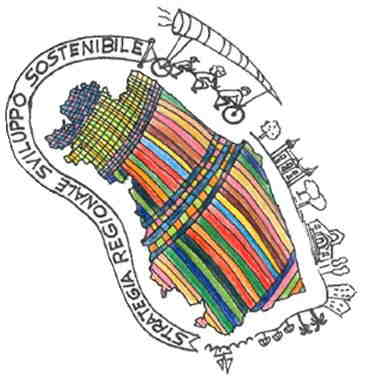
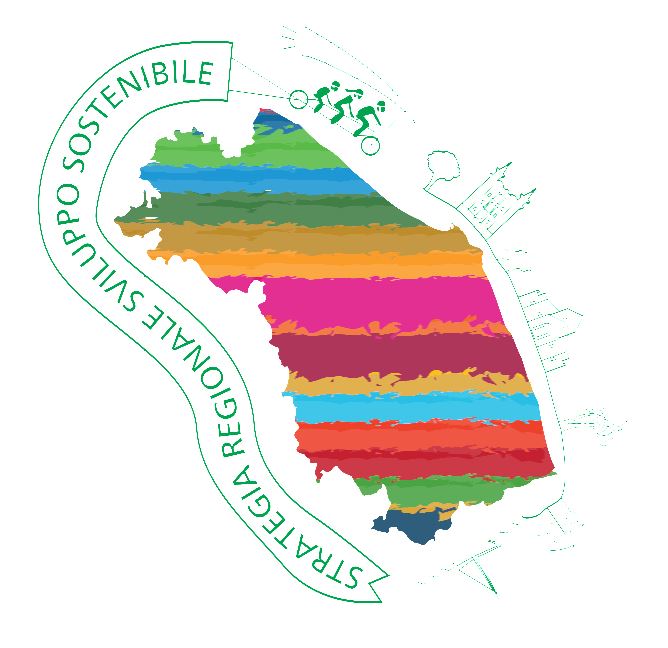
The choice of logo is not random:
- it is hand drawn because the strategy must be developed with citizens, men and women who are personally involved in the journey
- the Region dresses in sustainability and the dress has all the colours of the 2030 Agenda Goals
- just by "riding" together we will achieve the goal.
The second version of the logo is the digital one: however, it continues to represent the Sustainable Development Strategy regional vision
DOWNLOAD THE STRATEGY RESOLUTION OF APPROVAL
The Strategy has been defined in line with the required process innovation, which concerns the strong connection of 4 areas of action: namely the social, environmental, economic and institutional ones, in order to overcome the "sectoral" approach.
The Strategy identifies five strategic choices, which are supported by enabling factors, defined as sustainability vectors. Vectors have been developed into 19 objectives and the implementing actions have been already identified. In addition, the SRSvS has developed a particular focus on the theme of territorial resilience for which it has identified three directions of development.
REGIONAL STRATEGIC CHOICES:
A. Preventing and reducing the risk of disasters by reducing the hazards exposure and the vulnerability, increasing the capacity of response and recovery, and thus strengthening resilience;
B. Addressing the issue of climate change and the related social and economic asymmetries;
C. Recognising the ecosystems value and then protecting biodiversity;
D. Pursuing equity, by tending towards the eradication of poverty, inequality for what concerns the development benefits and the realization of dignity conditions for everyone’s life;
E. Promoting industrial research and technological innovation toward the development of new sustainable productive solutions for what concerns energetic innovation and efficiency, emissions reduction in the environment, recovery and reuse of by-products and waste, and development of biocompatible productions.
SUSTAINABILITY VECTORS:
- - Common knowledge;
- - Capacity building;
- - Education, awareness-raising, communication;
- - Subsidiarity, participation and partnerships.
THREE RESILIENCE DIRECTIONS:
- Regional and interregional green infrastructure;
- Adaptation to climate change (central Apennine river basin);
- Resilient municipal planning methodology.
The SRSvS defines the framework for the Strategic Environmental Assessment – SEA, and, to this end, the contribution indicators that must be used in the SEA have been identified, and they are related to the context indicators of the Strategy, with the target identification.
DD N 115 DEL 16/05/2023 – APPENDIX 5 INDICATORS
pagina aggiornata al 29/05/2023